


Heavy Steel Plate Cutting: Flame vs Plasma Cutting for Industrial Components
Heavy steel plate cutting is the starting point for many custom industrial components. The right cutting method affects edge quality, dimensional accuracy, machining allowance, welding preparation and the total manufacturing cost.
For equipment manufacturers, the key question is not simply whether a supplier can cut steel plate. It is whether the cutting process matches the material, thickness, drawing requirements and the next manufacturing stage.
This guide explains how flame and plasma cutting are used for heavy steel components and what buyers should confirm before placing an order.
1. WHAT IS HEAVY STEEL PLATE CUTTING?
Heavy steel plate cutting is the process of cutting thick or large-format steel plate into parts, blanks or profiles according to customer drawings.
The cut parts may be supplied directly, or they may continue through welding, drilling, boring, milling, turning or assembly. For projects that require several processes, plate cutting should be planned together with the complete heavy steel fabrication route.
Typical applications include:
- Machine bases and base plates
- Equipment frames
- Heavy brackets and supports
- Welded steel components
- Mining and construction equipment parts
- Custom industrial machinery components
2. FLAME CUTTING FOR THICK STEEL PLATE
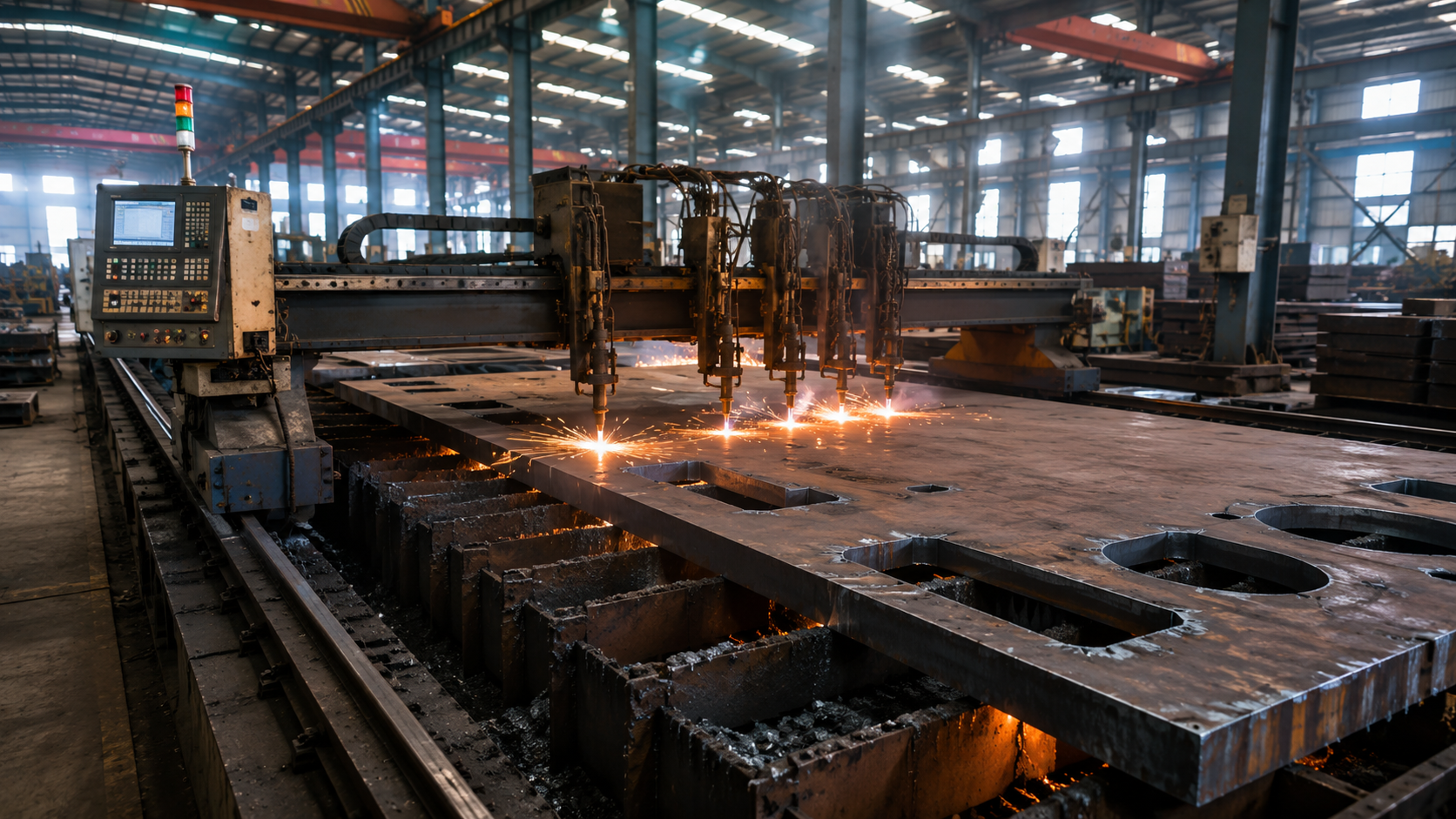
Flame cutting is widely used for carbon steel plate, especially when the plate is thick or the required part size is large.
At VHOFAB, flame cutting capability supports:
- Steel plate thickness up to 500 mm
- Cutting size up to 3,500 × 15,000 mm
- Custom shapes based on customer drawings
- Large and heavy steel components
Flame cutting is often suitable for heavy machinery components where material thickness and large dimensions are more important than very fine edge finish.
When the part will be machined later, machining allowance should be considered before cutting so that critical surfaces can reach final dimensions after CNC machining.
3. PLASMA CUTTING FOR STEEL COMPONENTS
Plasma cutting is another common thermal cutting process used for steel plate. It can provide faster cutting speeds and a narrower cutting zone on suitable plate thicknesses.
The best choice between flame and plasma cutting depends on:
- Steel grade
- Plate thickness
- Part dimensions
- Required edge quality
- Dimensional tolerance
- Production quantity
- Whether machining or welding follows
Instead of selecting a cutting method only by price, buyers should evaluate the complete production requirement. Our integrated fabrication capabilities allow cutting requirements to be reviewed together with welding and CNC machining needs.
4. FLAME CUTTING VS PLASMA CUTTING
Both processes are useful, but they serve different manufacturing needs.
- Flame cutting: suitable for thick carbon steel plate and large-format parts.
- Plasma cutting: suitable for many steel plate applications where faster cutting and a narrower cut are beneficial.
The correct process should be selected according to the drawing and the next manufacturing step. A part that requires heavy welding or CNC machining may need different cutting allowances than a simple cut plate blank.
For this reason, the supplier should review not only the cutting drawing but also the final dimensional and assembly requirements.
5. MACHINING ALLOWANCE AND FINAL TOLERANCE
One of the most important issues in heavy plate cutting is deciding how much material should remain for later machining.
If a component requires precision surfaces, holes, mounting faces or bearing positions, the cut blank should normally include enough allowance for final CNC machining.
Typical operations after cutting may include:
- CNC milling
- Boring
- Drilling and tapping
- CNC turning
- Surface machining
- Weld preparation
Planning these operations before cutting can reduce rework and help control the final dimensions of the component.
6. WHAT SHOULD BUYERS PROVIDE FOR A QUOTATION?
Clear technical information helps the supplier select the correct cutting method and calculate an accurate quotation.
Buyers should provide:
- PDF, DWG or DXF drawings
- Material grade
- Plate thickness
- Part dimensions
- Required quantity
- Dimensional tolerances
- Machining allowance requirements
- Welding requirements
- Material certificate requirements
- Inspection requirements
If the part is one stage of a larger welded or machined assembly, providing the complete drawing can help the supplier understand critical interfaces and final tolerances.
7. WHY INTEGRATED CUTTING, WELDING AND MACHINING MATTERS
When cutting, welding and machining are handled by separate suppliers, every transfer adds communication, handling and dimensional risk.
An integrated manufacturing supplier can review the whole route from raw steel plate to finished component and coordinate:
- Material preparation
- Plate cutting
- Welding sequence
- Machining allowance
- Final tolerances
- Inspection before delivery
This is especially useful for industrial equipment applications where components may be large, heavy and produced to customer-specific drawings.
If you are comparing suppliers for this type of work, see our guide on how to choose a steel fabrication supplier for heavy equipment components.
8. HEAVY STEEL PLATE CUTTING AT VHOFAB
VHOFAB supports custom steel components from plate cutting through welding and CNC machining.
Our production capabilities include:
- Flame cutting
- Plasma cutting
- Heavy welding
- CNC milling
- Boring
- CNC turning
- Drilling
- Assembly and dimensional inspection
Customers can order cut steel parts only, cut-and-machined components, welded components or more complete fabricated assemblies according to project requirements.
REQUEST A QUOTE
Need heavy steel plate cutting for your next project?
Send us your drawings, material grade, plate thickness, quantity and processing requirements. We can review the cutting method and any subsequent welding or machining requirements.